Emergency Plumbing in Tacoma & Pierce County 24/7 Human Support Free Second Opinion Quality Plumbing Services
Emergency Plumbing in Tacoma & Pierce County 24/7 Human Support Free Second Opinion Quality Plumbing Services
Emergency Plumbing in Tacoma & Pierce County 24/7 Human Support Free Second Opinion Quality Plumbing Services
Emergency Plumbing in Tacoma & Pierce County 24/7 Human Support Free Second Opinion Quality Plumbing Services

Text Us: 253-231-7015
Call Us: 253-231-7015
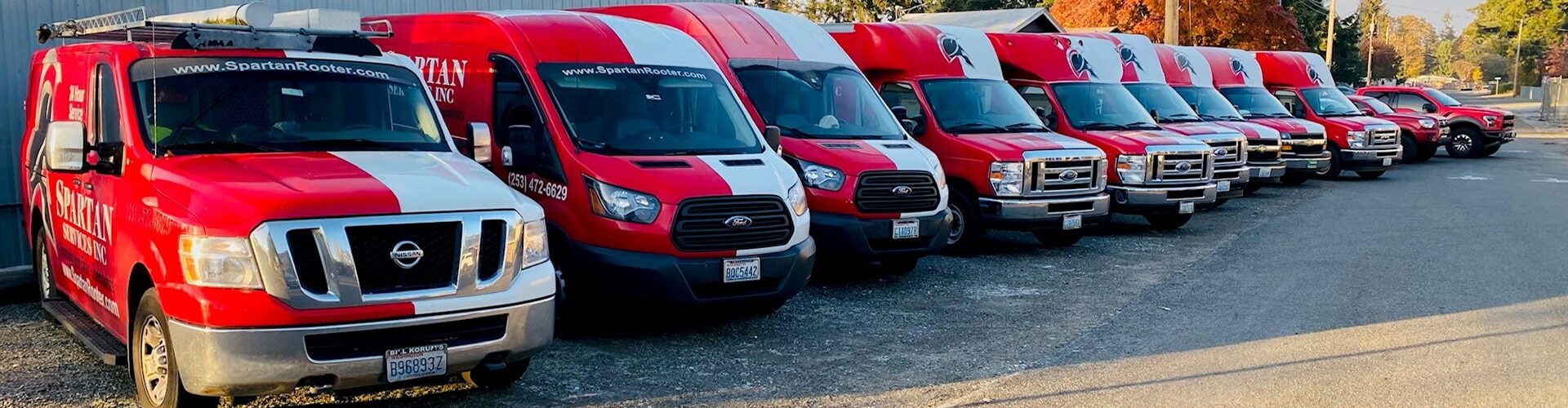

A leak in a commercial building is rarely discovered where it started. It surfaces as a stained ceiling tile, a damp patch of carpet, or a water bill that climbed without explanation. At Spartan Plumbing Inc., we have located and repaired commercial pipe failures across Pierce County since 1958.
We find the source before opening anything, so the ceiling, wall, or slab is opened at the failure rather than anywhere it might be. Our crews are licensed and insured, pricing is written before repair work begins, and 24/7 emergency response covers a line that has already burst.
Our team will show you what failed and explain whether it is an isolated fault or the first sign of a run reaching the end of its life. That distinction changes what you should do next.
The Colonial Center opened in 1937 as one of the first suburban shopping centers in the country and expanded through the 1950s, and commercial buildings from that generation are still in use across Lakewood. Their supply lines have been under constant pressure for decades.
Pinholes develop from internal corrosion over long periods, weep rather than spray, and can run above a ceiling for months before anything visible appears.
Commercial buildings hide their plumbing well. A leak above a suspended ceiling spreads laterally along the tile grid, so the wet spot is frequently a long way from the failure.
By the time it is visible the water has usually been running for a while, and the damage has moved into insulation, framing, or tenant stock.
The Pacific Northwest does not have a severe winter, but it gets cold enough to freeze an exposed or poorly insulated line. Loading docks, unheated storage, roof plant, and exterior hose bibbs are where we find most of them.
The split usually appears when the ice thaws rather than while it is frozen, which is why the failure often arrives after the cold snap has passed.
Every remodel, tenant fit-out, and equipment change disturbs joints that were previously undisturbed. A fitting that was reseated imperfectly can weep for years before it lets go.
In a building that has turned over tenants repeatedly, that history accumulates in places nobody has a record of.
A concealed leak shows up on the bill long before it shows up on a ceiling. Water in Lakewood is supplied by the Lakewood Water District, a separate body from the sewer provider, so the consumption signal is clean.
A rise with no change in operation is one of the most reliable early indicators available, and it is routinely ignored.
Supply lines under a commercial slab are the most expensive category to reach and the easiest to misdiagnose. Exploratory cutting is destructive and slow.
Locating the failure precisely before anything is opened is what keeps a slab repair proportionate to the fault.
Every job runs the same way. We look at the system, tell you plainly what we found, put the estimate in writing before we start, and finish to code. Here is the rest of what we cover for commercial properties.
Pressurized water cuts grease, scale, and debris out of commercial drain lines, and a paired high-definition camera run shows the inside of the pipe before and after, so the result is on record rather than guessed at.
Cured-in-place lining rebuilds a failed or cracked sewer line through small access points, sparing parking lots, landscaping, and flooring. Where the line is too far gone, we replace it outright with as little disruption as the site allows.
Commercial tankless installation and repair for operations that need hot water on tap all day. On-demand units drop the standby energy a tank wastes and remove the recovery wait between draws.
Full commercial repiping for buildings running corroded, undersized, or out-of-spec supply lines. We pull the failing system and put in modern materials rated to carry the building’s demand for decades.
Tenant-improvement plumbing, fixture and appliance hookups, supply-line repairs, and full system upgrades. New space or existing, we take it from first cut to final connection.
Repair and replacement of broken downspouts that carry water off your foundation, plus sump pump fixes and primary or backup pump installs that keep below-grade space dry through a storm.
Diagnosis, repair, and full replacement for commercial tank heaters across every major brand and size, getting the hot water back on quickly so the operation keeps moving.
Scheduled and emergency work on pinholes, burst lines, and freeze damage anywhere in the building. We pin the source down first so the wall or floor only opens where it has to.
Motorized cabling and hydro jetting on floor drains, floor sinks, mop sinks, kitchen lines, and main sewers. We clear the full length of the line rather than punching a single hole through the clog and leaving the rest in place.
Full support across tank, tankless, and heat pump units, including scheduled maintenance plans that stretch equipment life and head off the surprise failures.
Complete plumbing for commercial kitchens, restroom renovations, tenant improvements, and whole-facility remodels, coordinated with your contractor or property manager to hold the schedule and the budget.
Heat pump water heater installation and repair for operations chasing lower utility costs, since these units draw far less power than standard resistance heating and can pay back well in this climate.
Scheduled and emergency cleaning for every commercial drain type, from grease traps to floor drains to the main building sewer, stopping the backups and floods that shut a business down before they start.
Video inspection of commercial sewer lines to locate root intrusion, collapse, offset joints, and blockages, giving you a clear read on the system before you commit to any repair or replacement.
The everyday commercial list handled by one licensed team: valves, fixtures, backflow devices, supply lines, and the small repairs that sit on a punch list until they turn into an after-hours call.
A burst supply line keeps delivering until the main is closed, and the damage is cumulative by the minute. Nothing else on the list matters until the flow stops.
Isolate at the main if you can reach it, cut power to any area where water is near electrical equipment, then call.
Staining means water has already been present long enough to travel. Replacing the tile without finding the source guarantees a repeat.
That is the point to locate rather than redecorate.
Consumption rising while operations stay flat means water is going somewhere it should not. That is measurable rather than speculative.
It is also the cheapest moment to act, because the leak is still small enough to be looking for.
Freeze splits typically surface during the thaw rather than during the freeze. A building that came through a cold spell without incident is not necessarily clear.
Checking exposed runs after the thaw catches the ones that have opened but not yet been noticed.
A sudden drop rather than a gradual one suggests a failure rather than a restriction. Those are different problems with different urgency.
Sudden loss with no work having been done is worth treating as a leak until proven otherwise.
Running water audible when no fixture is open is the simplest positive test available. It means flow is continuing somewhere.
The same applies to a water meter that keeps moving with the building shut down.
Non-invasive location means we identify the failure first and open the ceiling, wall, or slab at that point. The alternative is exploratory demolition, which in a commercial building costs more to make good than the repair itself.
A pinhole in a supply line often means the run itself is at the end of its service life, and repairing one spot on a failing line buys months. We tell you which situation you are in so the next decision is made with the full picture.
A line that froze once will freeze again in the same conditions unless something changes. We address insulation, routing, and isolation on exposed runs rather than simply replacing the split section.
When a failure has caused damage, an insurer and often a tenant will want to know what failed, where, and when it was found. We document the location, the cause, and the repair so you have something concrete to submit.
Lakewood business owners and property managers choose us for licensed professionals, upfront pricing with no hidden fees, code-compliant work that passes inspection, and repairs built to last.
Spartan Plumbing is licensed and certified to work on your Lakewood property.
Upfront estimates before work begins. No hidden fees or surprise charges after the fact.
We know the permit path, the inspection points, and the commercial code that applies in Lakewood.
Commercial-grade materials, pressure-tested connections, and documented work on every project.
We work around your operating hours where we can and keep the space clean while we work.
A concealed leak is still running, and every week it goes unfound is more water on the bill and more moisture in the structure. The repair does not get cheaper for having waited, and the damage around it does not stop growing.
At Spartan Plumbing Inc., we have served Pierce County businesses, Lakewood included, since 1958, with 24/7 human support for the line that has already let go. Call us today at 253-231-7015 to book leak or freeze repair.
Watch for a water bill that rose without an operational change, staining on ceilings or walls, a musty smell in one area, or the sound of running water with everything closed. The clearest test is the meter: if it moves with the building shut down, water is going somewhere.
It depends on how accessible the area is, whether the failure is above a ceiling, in a wall, or under a slab, how much of the system has to be isolated to find it, and what the repair itself requires. You get a written estimate before repair work begins.
We narrow the location using pressure behavior, moisture readings, and the layout of the run before anything is opened. The ceiling or wall is then opened at the source rather than in several places while searching, which matters when the making good is commercial finish.
Pinholes develop from internal corrosion over a long period, and they are strongly associated with the age of the line. In buildings from the mid-century era, which is much of Lakewood commercial stock, a supply line under pressure for decades is a realistic candidate.
Often, yes. A single pinhole on an otherwise sound run can be repaired. Repeated pinholes on the same run usually mean the line has reached the end of its service life, and repairing one spot at a time becomes more expensive than replacing the section.
Sometimes, if it is caught while still frozen, but never apply an open flame. Shut off the main, open the nearest outlet so melting water has somewhere to go, and call. Most splits become visible when the ice thaws rather than while it is frozen.
Exposed and unheated runs: loading docks, unheated storage, roof plant, exterior walls, and outdoor hose bibbs. Those are the areas worth insulating and isolating before a cold snap rather than after one.
Yes. Depending on the location and the condition of the line, the options are a spot repair through the slab, rerouting the affected run, or replacing the line. Locating it precisely first is what decides which of the three is proportionate.
If you can see active water, yes, isolate at the main and call. For a suspected slow leak with no visible water, leaving the supply on lets us observe pressure behavior, which helps locate it. Tell us what you are seeing when you call and we will advise.
That depends entirely on your policy and on what caused the failure, which is a question for your insurer rather than for us. What we can do is document precisely what failed, where it was located, and what the repair involved.
Water in Lakewood is supplied by the Lakewood Water District, which is a separate body from the Pierce County Sewer Division that handles the sewer, and from the City of Lakewood which permits building work. Three different organizations.
Usually. Isolating the affected section rather than the whole building is the key, and where usable isolation does not exist we can often add it as part of the work. We tell you upfront where a wider shutdown is unavoidable.
 Book Now!
 Book Online