Emergency Plumbing in Tacoma & Pierce County 24/7 Live Answer Free Second Opinion Quality Plumbing Services
Emergency Plumbing in Tacoma & Pierce County 24/7 Live Answer Free Second Opinion Quality Plumbing Services
Emergency Plumbing in Tacoma & Pierce County 24/7 Live Answer Free Second Opinion Quality Plumbing Services
Emergency Plumbing in Tacoma & Pierce County 24/7 Live Answer Free Second Opinion Quality Plumbing Services

Text Us: 253-231-7015
Call Us: 253-231-7015
Hydro-jetting is usually better than snaking for grease, sludge, roots, and drains that keep clogging, because it scours the pipe walls instead of punching one hole through the blockage. Snaking is often the better first move for a single slow fixture, a hair clog, or an object stuck close to the drain. In Kent, the right choice depends on the symptom, where the clog sits, and how sound the line is once a plumber has looked at it.
Your kitchen sink in Kent cleared after the last snaking, and a few weeks later the water is pooling again. Now you’re wondering if hydro-jetting would have fixed it the first time, or if it’s more than a kitchen drain really needs.
Kent homes in King County, from West Hill across the Kent Valley floor to East Hill, were not all built in the same era, so the drain lines under them differ too. That’s why choosing a method for drain cleaning service should start with the symptom and how the drain behaves, not a default tool.
At Spartan Plumbing Inc., we have been clearing drains since 1958 as a licensed and insured team based in Tacoma, and that work reaches Kent homes too. Contact us today to find out whether your Kent drain needs a snake, a jetter, or a closer look first.

A drain snake, also called a drain auger, is a flexible steel cable that a plumber feeds into the line and turns until the head breaks up or hooks the blockage. It works well on a clog that sits in one spot, but it usually opens a channel through the buildup instead of removing what coats the pipe walls.
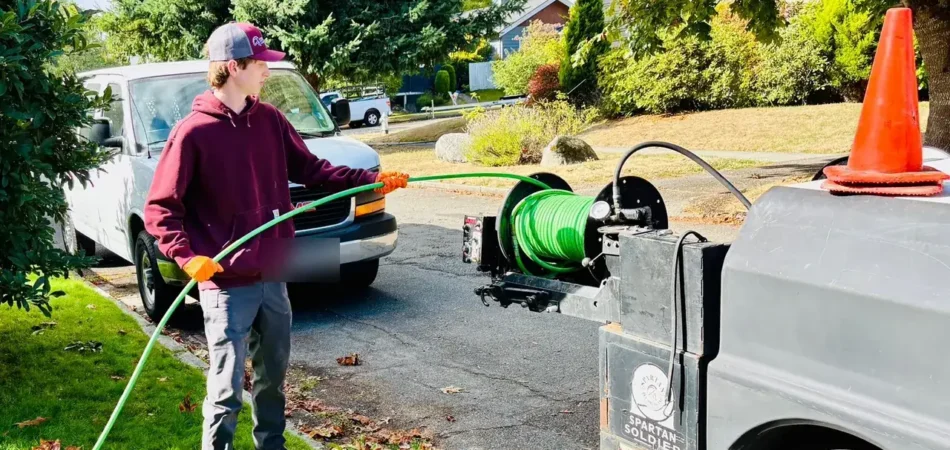
Hydro-jetting sends a high-pressure stream of water through a hose and a nozzle that pulls itself down the line. The rear-facing jets clean the sides of the pipe and flush the residue out, and a root-cutting nozzle can also slice through roots.
For a Kent homeowner, the useful question is what is causing the clog, how far down the line it sits, and whether the pipe can handle high-pressure water.
Snaking is often the simpler fix when the problem sits close to one fixture. In these cases a cable is usually the first tool, and our reliable Kent plumbing services cover both methods.
Jetting earns its place when the problem is spread along the pipe, not stuck in one spot. These three patterns usually point that way.
A drain that keeps coming back after it was snaked is a common sign that the cable punched through the clog but left the buildup behind. Each time, the opening it made fills in again with the same grease, soap, or sludge.
Jetting cleans the pipe walls along the run, which removes the material the next clog would have formed on. If your Kent kitchen or laundry line has needed the cable more than once in a season, ask about jetting before the next visit.
A plumber should still check the line first, since a sag or broken section can also cause repeat clogs.
Kitchen drains collect fats, oils, and grease that cool and harden on the inside of the pipe. A cable can poke through that layer, but the coating stays and keeps catching food scraps. In a busy kitchen, it can coat a long stretch of pipe before the sink slows.
Jetting scrubs that layer off and flushes it toward the sewer, which is why it is a common fix for a greasy kitchen line in a Kent home. Once the line is clean, scrape pans into the trash and wipe greasy cookware before washing it, so the coating builds back more slowly.
Tree roots can grow into small cracks and loose joints in older sewer pipes, then catch paper and waste until every drain in the house slows at once. A big tree near the path of your sewer line, on East Hill or close to downtown Kent, makes roots worth suspecting.
A root-cutting nozzle on a jetter can cut through the roots and rinse the pieces out of the pipe. Roots that return quickly often point to a damaged pipe, and at that stage a sewer line camera inspection helps show whether repair or lining makes more sense than another round of cleaning.
Use this grid as a starting point for a Kent home, not a final answer. The line’s age, material, and condition can change the call once a plumber has inspected it.
| Symptom | Likely Cause | Method That Usually Fits |
|---|---|---|
| One slow bathroom sink or tub | Hair and soap caught near the drain | Snaking with a small hand cable |
| Kitchen sink that keeps clogging | Grease and food coating the pipe walls | Hydro-jetting to clean the line |
| Several drains slow at the same time | A blockage in the main sewer line | Snaking to relieve it, then jetting if buildup remains |
| Main line clogs again and again | Roots growing in through cracks or loose joints | Jetting with a root-cutting nozzle, then a check of the pipe |
| Wipes or paper backing up | Items that should never be flushed | Snaking or jetting, based on how far the buildup reaches |
High-pressure water is strong enough to make a weak pipe worse. A cast iron line that has rusted thin, a clay line with separated joints, or a section that has already collapsed can be damaged further by jetting.
That is why we check the line’s condition and how it responds before choosing jetting for an older home on West Hill or in the Kent Valley. Sometimes a cable clears the blockage more gently, and sometimes the honest answer is that the pipe needs repair, not another cleaning.
If you already have a recommendation for one method and want it checked, we offer a Free Second Opinion in plain terms. You also get an upfront written estimate before any work starts on your Kent drain.
We help Kent homeowners with slow sinks, recurring kitchen clogs, and root problems in older sewer lines. At Spartan Plumbing Inc., we have been a Tacoma team since 1958, with licensed and insured technicians and 24/7 human support.
When the same drain clogs again soon after snaking, or several drains slow at once, it is time to have the line checked, and we explain what we found and price any hydro-jetting in Kent in an upfront written estimate. Give us a call at 253-231-7015 to get a slow or recurring Kent drain cleared with the method that fits it.
For grease, sludge, roots, and drains that keep clogging, hydro-jetting usually does the better job because it cleans the pipe walls instead of opening one path through the blockage. For a single hair clog or an object near the drain, snaking is often faster and simpler.
Hydro-jetting makes sense when the same drain clogs again soon after snaking, when grease has coated a kitchen line, or when roots keep returning in the sewer line. It also suits long runs with buildup along their length. A plumber should confirm the pipe is sound enough for high-pressure water first.
It can if the pipe is already weak. Cast iron that has rusted thin, clay pipe with separated joints, or a partly collapsed section can be damaged further by high-pressure water. On a sound pipe, jetting is a standard cleaning method, which is why a plumber checks the line’s condition before choosing it.
Usually not. A drain snake breaks up or hooks the clog and opens a path for water, but grease, soap, and sludge can stay stuck to the pipe walls. That leftover coating is why some drains clog again after snaking, and why jetting is used when the buildup runs along the line.
There is no fixed timeline, because it depends on what caused the clog and how the drain is used afterward. A kitchen line kept free of grease, or a sewer line without new root growth, stays clear longer. Roots that return quickly usually point to a damaged pipe, not a cleaning problem.
Yes. A jetter fitted with a root-cutting nozzle can cut through roots inside a sewer line and flush the pieces out of the line. Cutting roots does not seal the cracks or joints they grew through, though, so roots that keep coming back usually mean the pipe needs repair or lining, not just more cleaning.
We don’t quote a flat price, because the cost depends on where the clog sits, how easy the line is to reach through a cleanout, how much buildup or root growth there is, and the pipe’s condition. For a Kent home, you get an upfront written estimate after the line is inspected and before work begins.
A drain that clogs again soon after snaking usually still has grease, soap, or sludge on the pipe walls, or roots growing back into the sewer line. It can also point to a sag or a broken section. In Kent homes, a repeat clog is the point to have the line checked and consider hydro-jetting.
 Book Now!