Emergency Plumbing in Tacoma & Pierce County 24/7 Live Answer Free Second Opinion Quality Plumbing Services
Emergency Plumbing in Tacoma & Pierce County 24/7 Live Answer Free Second Opinion Quality Plumbing Services
Emergency Plumbing in Tacoma & Pierce County 24/7 Live Answer Free Second Opinion Quality Plumbing Services
Emergency Plumbing in Tacoma & Pierce County 24/7 Live Answer Free Second Opinion Quality Plumbing Services

Text Us: 253-231-7015
Call Us: 253-231-7015
In a Tacoma plumbing emergency, immediately shut off the main water valve to stop flooding, turn off your water heater, and call a 24/7 plumber. Focus on reducing damage by stopping water flow and turning off electricity to affected.
Most plumbing emergencies in Tacoma happen at the worst possible time: a burst pipe at 2 AM during a January cold snap, sewage backing up on a Saturday morning, no hot water before work on a Monday. Older homes in North End, South Tacoma, Hilltop, and the Proctor District are especially vulnerable because their supply lines often run through uninsulated crawlspaces, and many still carry the original cast iron drain stacks or galvanized supply lines installed before 1970. During the deepest Pacific Northwest cold snaps, that vulnerability turns into emergency calls fast.
At Spartan Plumbing Inc. (LIC #SPARTSI794OC), our team has handled emergency plumbing calls for Tacoma and Pierce County homeowners since 1958, and our 24/7 line is answered by a live person every time. If you have an active emergency right now, call 253-231-7015.
If you are trying to figure out whether what you are seeing counts as one, the scenarios below cover the most common ones and the right first move for each, or you can schedule a non-emergency assessment any time.
What follows is the order Tacoma homeowners ask us about most often, starting with the fastest-damage scenarios. Each section opens with a direct answer in bold, then explains the why. Use the triage table first to decide whether what you are seeing belongs in this list at all.
A plumbing emergency is any situation where water, sewage, or gas is doing something it should not be doing, right now, and waiting will cause property damage, sanitation problems, or safety risk. Burst pipes, sewage backups, gas smells, complete loss of water, no hot water in freezing weather, and active leaks all qualify. Slow drains, one dripping faucet, or low pressure at a single fixture do not, and trying to fix them at 11 PM usually makes things worse.
The triage question is simple: can the problem be shut off at a fixture stop valve and ignored until morning? If yes, it can wait. If no, it is an emergency.
| Situation | Call 24/7 | Can wait until morning |
|---|---|---|
| Burst pipe with active flooding | Yes | No |
| Sewage backup inside the home | Yes | No |
| Gas smell near plumbing fixtures | Yes (after evacuating and calling the gas utility) | No |
| Frozen pipe, no rupture yet | Sometimes | Often wait, keep cabinet doors open |
| No hot water during freezing weather | Yes | No |
| No hot water in mild weather | No | Yes |
| Multiple slow drains and gurgling toilets | Yes (main sewer warning sign) | No |
| Single slow drain | No | Yes |
| Visible water stain spreading on ceiling | Yes | No |
| One dripping faucet | No | Yes |
Shut off the main water valve immediately. Open the lowest faucet in the house (basement utility sink or outdoor hose bib) to let water drain out of the pipes after the main is closed. If the burst is near electrical fixtures or outlets, kill the breaker before approaching. Then call a 24/7 plumber. While waiting, contain water with towels, buckets, or a wet/dry vacuum, and move furniture and electronics out of the wet area.
Burst pipes are most common in Tacoma during deep winter cold snaps, especially in homes with supply lines running through uninsulated crawlspaces or exterior walls. The break is often not where the water is showing; water travels along studs and floor joists before it appears on a ceiling or wall, which is why a single visible stain often means a much larger soak inside the structure.
Do not try to solder, glue, or clamp the pipe yourself unless you have done it before and have the materials on hand. A bad repair under pressure can blow out and cause a second flood. The Insurance Information Institute lists water damage and freezing among the largest categories of homeowners’ insurance claims by frequency, which is one reason the right first action is to stop the water, not to fix the pipe.
Stop using all water in the home immediately, including sinks, showers, dishwashers, and washing machines. Sewage backups almost always come from a blockage downstream of your fixtures, so additional water use makes the backup worse. Keep people and pets out of the affected area, ventilate if possible, and call a licensed plumber for diagnosis. Do not pour chemical drain cleaners into a backed-up line.
If only one fixture is backing up, the blockage is local, and a snake or auger can usually clear it. If multiple fixtures back up at the same time, especially toilets and tub drains on the lowest floor, the blockage is in the main sewer line. That often signals root intrusion, a separated joint, or a collapsed lateral.
Older Tacoma homes with clay or cast iron laterals are particularly prone to main-line backups. The symptom is often gurgling toilets, slow drains throughout the house, or water coming up through floor drains. We handle this work through our drain cleaning service, and a follow-up camera inspection is often the right next step.
If a pipe is frozen but not yet ruptured, open the nearest faucet on that line so water can move once it thaws, and apply gentle heat to the frozen section with a hair dryer or heat tape. Never use an open flame, propane torch, or kerosene heater on a pipe. If the pipe has already burst or you cannot locate the frozen section, shut off the main and call a 24/7 plumber.
Tacoma winters bring multi-day cold snaps every few years that drop overnight temperatures into the teens or low 20s. Homes built before 1970, especially in the North End and Hilltop, often have supply lines routed through uninsulated crawlspaces or exterior walls that were not built for those temperatures.
Prevention details are covered in the next section, but the short version: a slow drip from a faucet on a vulnerable line keeps water moving, open cabinet doors expose pipes to room heat, and pipe insulation or heat tape on exposed runs is the cheapest insurance you will ever buy.
If you smell gas near a plumbing fixture, water heater, or anywhere in the home, leave immediately. Do not flip light switches, do not use phones inside, do not start vehicles in attached garages, and do not light matches. Once outside and at a safe distance from the home, call your gas utility’s emergency line first, then a licensed plumber. If anyone shows symptoms of exposure or the smell is strong, call 911.
Your gas utility dispatches around the clock for gas leak emergencies. The plumber’s role is to repair the affected appliance, line, or fitting once the gas company has shut off the supply and confirmed the area is safe.
Gas leaks at water heaters, furnaces, or gas range connections are not DIY repairs under any condition. Tampering with gas lines violates Washington state code and creates risk of fire, explosion, and carbon monoxide exposure.
A water heater that fails during freezing weather is an emergency because it creates real risk of frozen pipes inside the house, especially if the home is unoccupied or the heating system depends on hot water. Call a 24/7 plumber the same day. In mild weather, a water heater failure is uncomfortable but not an emergency, and most repairs can wait until next-day service at a non-emergency rate.
For Tacoma homes with electric tank water heaters, the most common failure modes are a tripped breaker, a failed heating element, or sediment buildup affecting the lower element. For gas tank heaters, pilot or thermocouple failures are common. Tankless and heat pump models have their own diagnostic patterns.
We service every water heater type through our water heater service line, including same-day repair and replacement when needed.
If water stops flowing from every fixture in the house at once, the cause is upstream of your plumbing: a closed main valve, a meter problem, a service line break between the meter and the house, or a city-side outage. Check the main shutoff first to make sure it has not been bumped or accidentally closed. If it is open and there is still no water, call your utility, then a 24/7 plumber.
In a Tacoma single-family home, a sudden total loss of water usually points to a service-line break (between the meter and the house) or a main shutoff that was closed during recent work. A service-line break may show as wet spots in the yard or driveway along the supply line path.
If the utility confirms there is no outage and water is reaching the meter, the problem is on your side of the meter and is a plumber’s call.
The main water shutoff valve in a typical Tacoma home is in one of three places: in the basement or crawlspace where the service line enters the house, behind an access panel in a utility room or garage, or at the curb stop in a meter box near the property line. Turn the valve clockwise (right) all the way to close. If the valve has not been turned in years, it may be stiff but should still close.
For older Tacoma homes in North End or the Proctor District, the main shutoff is most often in the basement near the front of the house, on the supply pipe just inside the foundation wall. For ramblers and post-1970s homes in South Tacoma and Hilltop, look in the garage, a utility closet, or a crawlspace access. Newer construction may have a labeled shutoff in the laundry room.
If you cannot find or operate the main, the curb stop at the property line will shut off all water to the house. The curb stop typically requires a meter wrench to operate, so in a true emergency, your first call should be to a 24/7 plumber who can locate and operate it. Find your main shutoff valve now, before you ever need it.
The cheapest emergency is the one that does not happen. Most of the calls we get during winter cold snaps could have been avoided with two hours of fall prep work.
Before the first deep freeze (target: October each year):
During a cold snap:
For year-round protection on older homes, a scheduled inspection through our annual maintenance plan catches small problems before they become 2 AM emergencies, and a sewer camera inspection takes the guesswork out of an aging lateral.
A plumbing emergency at 2 AM is the wrong time to find out your usual plumber’s office hours end at 5 PM. The number to have on your phone, on your fridge, or saved in your contacts is the one that answers live, every time, around the clock.
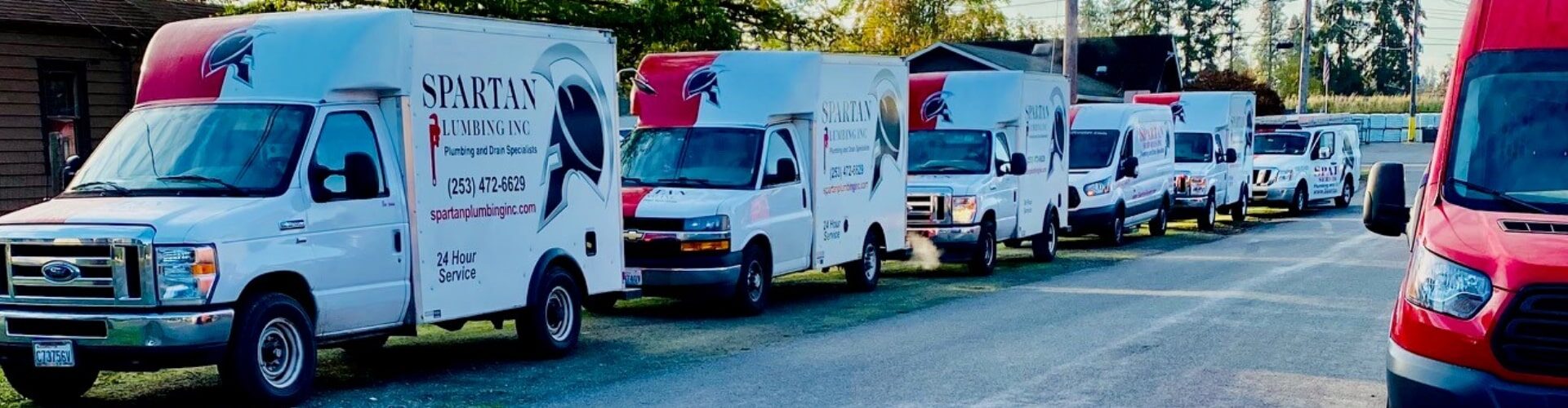
Spartan Plumbing Inc. has served Tacoma and Pierce County for 65+ years, since 1958. We answer the phone 24/7 with a live team member, dispatch with fully stocked trucks for one-visit repairs whenever possible, and provide a written estimate before any work begins. For active emergencies, our 24/7 emergency plumbing service dispatches the closest available crew. Call us right now if you have an active emergency, or save the number for the next one.
Any sudden plumbing failure that threatens safety, sanitation, or property: burst pipes, active flooding, sewage backups, gas smells, complete loss of water, no hot water during freezing temperatures, and water heater rupture. Slow drains, a single dripping faucet, or low pressure on one fixture are not emergencies and can wait for normal hours.
Shut off the water at the closest valve (fixture stop or main shutoff), kill power to any affected water heater or pump, move belongings out of the wet area, and open windows for moisture control. For gas emergencies, leave the home first and call from outside.
In most Tacoma homes the main is in the basement or crawlspace where the service line enters, behind an access panel in a utility room or garage, or at the curb stop near the property line. Turn the valve clockwise to close. If you cannot locate or operate it, call a 24/7 plumber.
No. A single clogged toilet that responds to a plunger or stays contained in the bowl is not an emergency. A toilet that overflows repeatedly, gurgles when other drains run, or backs up alongside tub or shower drains is an emergency because it points to a main sewer-line problem.
Leave a slow drip from a faucet on a vulnerable line, open cabinet doors under sinks on exterior walls, disconnect garden hoses before the first freeze, and wrap any uninsulated crawlspace or exterior-wall supply lines with pipe insulation or heat tape before December.
Emergency plumbing pricing varies by job type, time of day, and parts needed. Industry estimates put after-hours service call rates noticeably higher than business-hours rates, with most residential emergency calls landing between a few hundred and a few thousand dollars depending on scope. We provide a written estimate before any work begins.
For active emergencies in Tacoma and Pierce County, we dispatch the closest available technician immediately. Arrival time depends on traffic, weather, and current call volume, but emergency calls are prioritized ahead of scheduled work. Call 253-231-7015 for the current dispatch window.
Leave the home immediately. Do not flip light switches, use phones, or start vehicles in an attached garage. Once outside and at a safe distance, call your gas utility’s emergency line first, then a licensed plumber. If anyone shows symptoms of exposure or the smell is strong, call 911.
 Book Now!